Water · Earth · Community
Building AI for rivers and rain through Paani AI. Graduate researcher at the AIR Lab, Western Kentucky University. Part engineer, part wanderer, part storyteller.
Somnath Luitel — Engineer & Explorer
Civil engineer, climate researcher, and cofounder — working at the intersection of water, AI, and community.
Nepal · Western Kentucky University, USA"The river knows where it's going. My job is to listen."
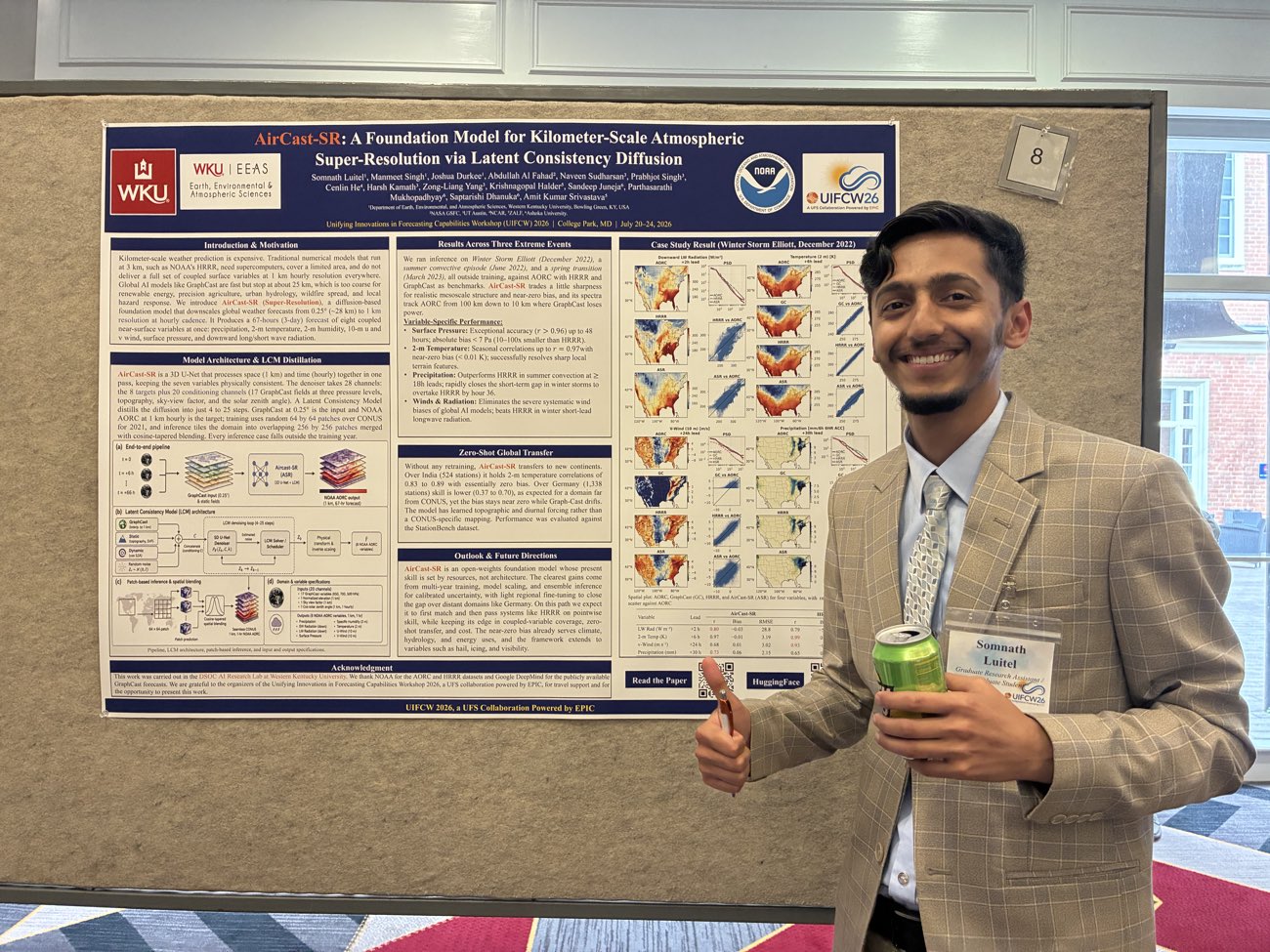
I'm Somnath Luitel — a graduate student in the Department of Earth, Environmental, and Atmospheric Sciences (EEAS) at Western Kentucky University, Bowling Green. I'm also a graduate researcher at the DSOC AI Research Lab (AIR Lab), working under the supervision of Dr. Manmeet Singh.
My research focuses on high-resolution climate data development, sub-seasonal to seasonal (S2S) climate modeling, and data-driven approaches for environmental prediction. I earned my Bachelor's in Civil Engineering from Pulchowk Campus, Tribhuvan University, Nepal.
I cofounded Paani AI — building flood forecasting tools, water quality models, and climate-resilient systems for Nepal and beyond. My published research spans flood hazard mapping at the settlement scale and InSAR-based land subsidence monitoring in Pokhara Valley.
Rooted in rivers, guided by data, built for communities.
Data science and machine learning for Nepal's water challenges — flood prediction, water quality analysis, and climate-resilient resource management.
Visit Paani AISettlement-scale flood hazard mapping and vulnerability analysis of building structures in the Sauraha region of Nepal. Published in JScE, 2024.
Read PaperSentinel-1 InSAR processing to assess land subsidence patterns in Pokhara Valley, Nepal. Published in JOETP, Vol. 5, 2024.
Read PaperGraduate research at the DSOC AI Research Lab, WKU — developing high-resolution climate datasets and AI-driven S2S prediction models for weather and climate.
Visit AIR LabWater resources, geohazards, and earth observation — from field to journal.
On water, engineering, society, and the examined life — in English and Nepali.
On leadership, accountability, and what we owe each other as citizens of Nepal.
ReadEngineering demand is rising steeply — but is the quality of education keeping pace?
ReadOn machine learning, hydrological forecasting, and what Paani AI is learning from Nepal's rivers.
Reflections on sustainable civil engineering and the engineer's role in a climate-disrupted world.
Leadership, accountability, and what we owe each other as citizens.
ReadRising demand for engineers and declining quality of education in Nepal.
ReadField surveys, mountain treks, community moments — the unscripted parts of the work.
Replace <div class="g-lbl"> with <img src="photo.jpg"> inside each .gbg to add your photos.
Engineering happens in offices — and also in river basins, mountain villages, and rain-soaked field sites.
Hydrology surveys in remote valleys and satellite ground-truthing in rugged terrain — where theory meets earth.
Nepal HimalayasWading rivers, collecting samples, reading landscapes — understanding how water moves is both science and instinct.
River Basins, NepalValidating Sentinel-1 satellite imagery on the ground across Pokhara Valley — bridging orbit and earth.
Pokhara ValleyWorkshops and listening sessions in communities affected by water and climate risk. Science is only useful when it reaches people.
Rural NepalEvery journey ends with a book. The best engineering thinking often happens in transit, mid-trek, or watching a river at dawn.
Wherever I AmFrom Nepal to Western Kentucky — pushing AI-driven climate science at the DSOC AI Research Lab, building next-gen weather and climate models.
Bowling Green, KYOpen to research collaborations, speaking invitations, or a conversation about rivers and books.
Whether you're a researcher, student, journalist, NGO, or someone who cares about water and climate — every conversation is worth having.
Civil engineer, climate researcher, and Paani AI cofounder. Graduate researcher at the DSOC AI Research Lab, WKU. Expertise in water resources, InSAR remote sensing, S2S climate modeling, machine learning, and high-resolution climate data development.